
The Times 9th April 2025 - Military service and Britain the warrior nation - 36 Downloads
The Times - Military service and Britain the warrior nation
9th April 2025, David A Rew, Consultant Surgeon
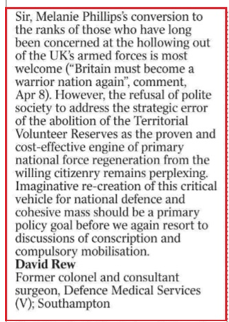
“Sir, Melanie Phillips’s conversion to the ranks of those who have long been concerned at the hollowing out of the UK’s armed forces is most welcome (“Britain must become a warrior nation again”, comment, Apr 8). However, the refusal of polite society to address the strategic error of the abolition of the Territorial Volunteer Reserves as the proven and cost-effective engine of primary national force regeneration from the willing citizenry remains perplexing.
Imaginative re-creation of this critical vehicle for national defence and cohesive mass should be a primary policy goal before we again resort to discussions of conscription and compulsory mobilisation.
David Rew
Former Colonel and Consultant Surgeon, Defence Medical Services (V); Southampton”
Background
All but 18 months of my 43 years of parallel service to the Crown between 1975 and 2018 was spent in the Territorial Army Volunteer Reserve (TAVR) (TA)before it was rolled up into the Army Reserve.
The TA had an illustrious history as the nation’s de facto mobilisable civilian militia from its creation in 1908 as the Territorial Force, which became the Territorial Army in 2021 to its abolition in 2015 and the role up of its functions into the Army Reserve.
Contrary to the best efforts of the propagandists, Britain always had two armies; The Regular Army and the TA/TAVR.
The Regular Army had a great tradition as Britain’s expeditionary army, with so many of its battle honours won across the Channel on the European landmass. However, it was always hidebound by the realities and costs to the public purse of employing a standing army, and the associated career management costs and manoeuvring which went with it.
In contrast, the Territorial Army was a more maverick organisation of individuals who went “over and above” lives to serve the country on a voluntary basis in their peacetime civilian lives, and who brought a particular energy and creativity on mobilisation. The TA was a critical element in force regeneration in the First and Second World Wars, and a major source of technical and clinical specialists right up to the end of the Afghanistan Campaign (Op Herrick) in 2013.
In my experience and observation, the TA was never fully understood and welcomed in its format outside regular army career promotion and appraisal norms. However, it was ultimately subservient and under-represented at Higher Command level. It was nevertheless an important national asset in its time, given that the per capita cost of a Territorial was a fraction of that of a Regular serviceman or woman; and that the TA was the community expression of the national martial power.
The TA was progressively starved of resources and influence, and its remnants were rolled up into the new Army Reserve in 2015. The Army Reserve was more integrated into the Regular Army and the formal service “offer” was very different to that to the Territorial.
By the earliest 2020s, the Regular + Reserve Army had shrunk to its lowest manpower since the 1800s. The shock of the Russian invasion of Ukraine in February 2022 gradually forced a realisation that the Army needed to regenerated once again, with a whole new set of skills in cyber, electronic and drone warfare.
This prompted General Sir Patrick Sanders, as Chief of the General Staff, to call in January 2024 for a debate on the "mobilisation" of British society to prepare a citizen army to support the regular military in potential conflict.
No reference was made to reconstitution of the TAVR as the proven national model and resource for the regeneration of the nation’s military forces in anticipation of the major European conflict which Russian behaviour threatened, and indeed the silence on the issue of the reconstitution of the TA/TAVR from senior regular and retired military offers has been deafening.
The words and processes of conscription and mobilisation are politically toxic in modern Britain, and the debate rumbled on for a year or so with little progress. Melanie Phillips therefore wrote an eloquent call to arms in the Comment section of The Times, but without direct reference to the TAVR. This prompted my letter that morning.
The text of Melanie’s article of April 8th 2025 in The Times is as follows:
Britain must become a warrior nation again
Decades of peace created a self-indulgent society - conscription for young offenders is a start. Suddenly we learn that Russia appears to have been spying on British nuclear submarines in the seas around Britain. Russian sensors hidden in UK coastal waters were discovered after a number of them washed ashore and were located by the Royal Navy.
Britain seems to have been living in a dream world. Senior serving military figures and retired generals have long cautioned that the cat and mouse of the Cold War is heating up again, and now warn that in the North Sea and Atlantic, conflict is brewing.
Who knew? After the fall of the Berlin Wall in 1989, it was widely assumed that the Russian threat had gone away. Now we learn it did not.
This discovery has surfaced when Britain and Europe are being forced to face up to their lack of military preparedness, having largely outsourced their defence to the US, for which President Trump is now refusing to pay.
For years, however, military experts have been increasingly concerned that Britain’s armed forces are no longer fit to defend the nation. Recent increases in defence spending are nowhere near enough to restore Britain to the status of a major military power. The number of troops has fallen from 100,000 full-time trained personnel in 2000 to approximately 70,000 today.
What a sad decline from what Britain once was: a warrior nation whose unmatched ability to wage war was intimately bound up with its idea of itself as a sovereign island nation fighting off all who menaced its precious independence and way of life. In that now mythic Britain, war and freedom were umbilically linked.
In recent years, the British have turned against war, largely as a result of the disastrous experiences in Iraq and Afghanistan. But the change surely has deeper roots. The very idea of a nation pulling together redoubt of what has been lost for the common good is steadily being eroded.
Decades of peace have produced a narcissistic and self-indulgent society, ratcheting up demands it has labelled “rights” and preoccupied by battles for power between different social, cultural and ethnic groups.
The result has been a loss of resilience, both on a personal and national level, an inability to surmount obstacles at home and weather shocks from abroad. The public sphere is full of fragile “snowflakes” apparently traumatised by imaginary “microaggressions” while ignoring or denying real aggression from global forces threatening the nation.
In the face of this cultural attrition, many view the armed forces as the last redoubt of what’s been lost — characteristics such as self-discipline, courage, pragmatism, stoicism, loyalty and gallantry that not only help defend the nation but create a civilised and productive community.
A public panel organised by the Prison Reform Trust has accordingly concluded that young people convicted of knife crimes should be forced to do national service. In principle, this is an excellent idea and shows there are still citizens who understand the importance of the values that are steadily being degraded.
It also shows understandable frustration with a criminal justice system that either sends offenders to do unchallenging community service that makes little difference to their lives, or sentences them to jail terms, which do little to turn their lives around.
In practice, the armed forces would hardly take kindly to being sent thugs for life-skills training. Yet this can produce impressive results. The Israel Defence Forces take school dropouts and other troubled teens and turn them around. For example, Fares and Firas Muhammad, Israeli Arab twins from Jerusalem, were both violent juvenile delinquents — and yet both became star members of a crack IDF commando unit.
There are calls to increase the numbers doing military service in order to boost Britain’s national defences. The former head of MI6, Sir Alex Younger, has suggested Britain may need to introduce a form of conscription in the face of new international threats. This would stop short of full military service for all. Thinking of Sweden, which in 2017 reintroduced a form of conscription for over-18s in response to Russia’s invasion of Crimea, he said it might involve government powers to compel Britons to “give their service one way or another”.
Younger was echoing General Sir Patrick Sanders, a former chief of the general staff, who said in January last year that Britain needed broadly to follow Stockholm’s example and take “preparatory steps” to place society on a “war footing” against an increasingly aggressive Russia. Such action was “not merely desirable, but essential”.
His remarks provoked a chorus of horrified disdain as if he had proposed turning Britain into some kind of military junta.
This is a society living in fantasy world. Having convinced itself that war (which is always hideous) is never justified, it is in effect abandoning the defence of freedom and its own core values while it gazes in either fascination or disgust at its own navel.
Faced with the violence of boys, it takes refuge in highly ideological theories such as “toxic masculinity” to avoid facing the inconvenient fact that the majority simply come from shattered family lives or other kinds of troubled personal backgrounds.
Whether over the erosion of values within or potential attack from without, the country is living in La-La land. And that is indefensible.