The Sunday Times - Defence opportunities
13th September 2026, Colonel David A Rew (ret'd) Territorial, regular and army reserve, Southampton
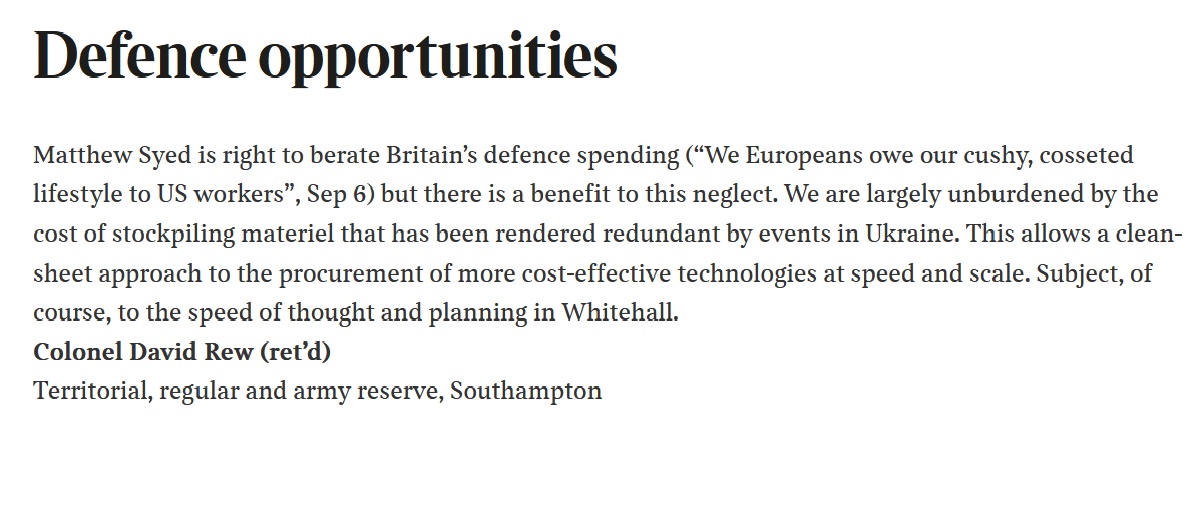
Sir. Matthew Syed is right to berate Britain’s defence spending (“We Europeans owe our cushy, cosseted lifestyle to US workers”, Sep 6) but there is a benefit to this neglect.
We are largely unburdened by the cost of stockpiling materiel that has been rendered redundant by events in Ukraine.
This allows a clean-sheet approach to the procurement of more cost-effective technologies at speed and scale.
Subject, of course, to the speed of thought and planning in Whitehall. David Rew
Background
Events in Ukraine since February 2022 have created an increasing sense of foreboding that Europe is once again slipping into a state of trans-continental warfare in consequence of continuing Russian aggression and European support for a remarkably resilient Ukraine in the face of a savage attempt to erase its national identity.
The Russian-Ukraine Theatre of War has also proved to be an effective testing ground for new forms of technological warfare, to which all democratic societies must rapidly adjust.
The sense of crisis has been heightened by the words and actions of a US Administration which seemingly encourage the Russians to persist and to undermine the unity of the North Atlantic Treaty Organisation.
Enduring and justifiable US concerns about the budgetary passivity of European countries in terms of effective actions to bolster Western defences have yet to be met by a UK Government and un-elected Prime Minister in Andrew Burnham who overtly prioritises welfare spending over defence spending.
A powerful polemic by Matthew Syed in the Sunday Times of 6th September 2026 prompted me to see a very faint light of positivity in the UK neglect of defence over the past two decades in the underspend on “heavy metal” weaponry whose vulnerability to drone warfare has been brutally exposed in the new era of drone warfare.
We Europeans owe our cushy, cosseted lifestyle to US workers
No wonder America mistrusts its Nato allies. It has spent the equivalent of $8 trillion more on defence
Matthew Syed The Sunday Times 6th September 2026

_____________________________________
On one thing, at least, Trump is right. He has been right for 40 years, ever since he took out ads in The New York Times, The Washington Post and The Boston Globe saying the US was being ripped off by its allies. He’s still right, and no whataboutery relating to his corruption and venality can alter this geopolitical truth. Europe is in serious danger because, even now, our way of life is based on a delusion that few will admit and none in power will explicitly state.
This is not just about the failure to spend on defence, by the way. The mantra trotted out by all politicians hoping to appear wise - “we must take defence more seriously” - has the status of cliché. We’re told “3.5 per cent of GDP by 2035”; “3 per cent by 2030”. It’s like a Dutch auction nobody believes, and our adversaries don’t take seriously, given the sheer amount of “tucking under” (pretending MoD civil service pensions and the like count as defence spending).
Besides, the idea that a few extra billion a year will make up for decades of freeriding, measured not just in legitimate American fury but the hollowing-out of nuclear, conventional and pipeline technology capability, is fantasy.
Let’s look at the reality. I’ll be generous here and ignore the period between 1950 and 2010, when American presidents were consistently warning about European delinquency. Let’s instead take the period from 2010 to 2025, when both Russia and China pretty much tripled defence spending in real terms, a stunning period of rearmament.
America could see with absolute clarity the risks on the near horizon and desperately sought to persuade European nations to take care of an area they dominated in economic terms, while watching military spending wither away and welfare states continue their inexorable growth. It’s an unprecedented anomaly that our continent is menaced by a nation - Russia - with just 10 per cent of its GDP.
The numbers are nothing less than extraordinary. The accumulated underspend of European Nato members from 2010 to 2025 - in other words, the deficit in relation to American spending as a proportion of GDP in the same period - runs to almost $8 trillion (in 2025 dollars). Not $8 billion, folks - $8 trillion.
Let me be crystal clear: when we say that we aim to reach American levels of defence spending in five or perhaps ten years’ time, while patting ourselves on the back, the US political establishment think we are gaslighting them. It’s like allowing the foundations of a house to crumble and offering to give the interior walls a lick of paint.
Yet here’s the thing: we are not gaslighting them. Most of our political class - which ventriloquises for European voters lost in fantasyland - seems to believe its own mythology. Our welfare states have effectively been subsidised by American taxpayers - some of the hardest-working and most productive in the world - for so long that we’ve come to believe we deserve them.
As one Labour backbencher put it: “Welfare is a human right.” I almost hesitate to break it to such people, but there are no human rights without the military power to resist those who would destroy them, a truth absolutely grasped in Washington but not at all in London, Paris, Brussels, Amnesty International, Human Rights Watch, the state bureaucracies and much of the judiciary.
I keep hearing centrist podcasters lauding Europe for our “enlightened economic model”. Behold Sweden, they say, with its capacious welfare state and high GDP per capita - living proof that soft socialism works! I admire Sweden in many ways, but am I the only one puzzled by what this analysis leaves out? Sweden would have no welfare state, indeed no state at all, without the implicit American military umbrella (Sweden only joined Nato in 2024).
Between 2010 and 2020 it spent an average of 1.1 per cent of GDP a year on defence. If this “Scandi miracle” had been required to deter aggressors (with or without the historic buffer of Finland, largely unaligned between 1945 and 2023), the spending would have swallowed its welfare budget whole.
And here’s perhaps the most crucial of the hard truths Europe chooses to ignore. Unlike America, China and Russia, whose economies have a modicum of self-sufficiency, Europe is utterly beholden to the global free trade that powered the postwar boom.
Without intricate supply chains to furnish it with parts, electronics and chemicals, Sweden (for example) would face economic collapse, turning its generous welfare state into a joke.
Our continent is menaced by a nation - Russia - with just 10 per cent of its GDP - Yet global free trade doesn’t happen by magic (or because of the human rights convention); it happens because hard power is employed to patrol shipping lanes, protect freedom of navigation and deter piracy. And who has borne this cost? Pre-eminently America and its huge naval fleet, first deployed by Jefferson in 1801 when the frigates President, Philadelphia and Essex were sent under the command of Commodore Richard Dale to tackle the Barbary corsairs off Tripoli.
I should perhaps say, if only for the avoidance of doubt, that I am not suggesting welfare states are untenable or undesirable. Merely that if you are going to keep expanding them through higher debt, a technique perfected in the UK and France in particular, you’d better make sure your growth rate is sufficient to service the interest payments.
This is precisely what has been rendered virtually impossible in the EU and UK by the excessive regulation of private capital and markets. No EU company worth more than €100 billion has been built from scratch in the last 50 years, while six US firms worth more than €1 trillion have been created in the same period, according to the Draghi report.
To put it simply, generous welfare states are testaments not to European socialism but to the American capitalism that funded them, without thanks or even acknowledgment.
In many ways Europe today is a Galapagos mammal that has been without predators for so long that its instincts have become aligned to a world that no longer exists, if it ever did. It is commonplace to blame Trump for betraying the western alliance, but the betrayal took place much earlier, masterminded by feckless European politicians who sold the myth of a “peace dividend” to voters who preferred comforting lies to hard truth.
Today we face a reality we dare not confront with an economic model that makes no sense and a protector edging away, while dominating the frontier AI models on which we are likely to increasingly depend.
Future columns will seek to map out possible ways forward for Europe, but no route comes without sacrifices that electorates seem unwilling to hear. It is why I am sick of reading commentary blaming America or Trump or Xi for the state of our continent when Europeans need only look at ourselves. We had the finest of inheritances - an era of peace, high living standards and cheap inputs - and responded with spending we couldn’t afford, entitlements we couldn’t sustain and regulation that strangled our dynamism.
When the reckoning comes, it will be more painful than many have yet realised. And those of us who have been issuing warnings for years will take no comfort from that whatsoever.