
The Sunday Times Letters September 12th 2010 - Duty of care to Afghan and Iraq Veterans - 28 Downloads
The Sunday Times - Duty of care to Afghan and Iraq Veterans
12th September 2010, David A Rew, Consultant Surgeon
The large numbers of physical and psychological casualties from operations in Iraq and Afghanistan impose a lifetime duty of care on us — more so now that many are to be discharged from military service. There sits on the south coast the magnificent and now mothballed former Royal Naval Hospital at Haslar, Hampshire, awaiting a new lease of life.
The MoD and the previous government were against sustaining Haslar as a military facility, in favour of a regional policy of care and rehabilitation. However, once the spotlight has moved away — and notwithstanding present best intentions — many of these casualties will drift and decline in health outside the protective cocoon of military life and welfare.
RNH Haslar offers the opportunity to create a national centre of excellence for long-term respite, rehabilitation, research and casualty care, outside the ownership of the MoD and under charitable management.
David Rew, Consultant Surgeon Southampton University Hospitals and the Defence Medical Services Reserve
Background
By late 2010, the Iraq Campaign had ended and the futility of ongoing operations in Afghanistan was increasingly apparent. The past decade had been an extraordinary personal and professional decade for me. Along with my own operational deployments to Iraq and Helmand, and the training commitments to sustain my particular skills and expertise to be effective in the unique environments to meet the demands of advanced trauma surgery and care in the combat badlands, I had an NHS surgical career and a family to sustain.
However, my personal considerations were as nothing to the life changing injuries and disabilities to which soldiers and marines who had survived the ravages of improvised explosive devices now had to adapt. Bryn Parry and his colleagues ultimately raised some £100M to support these youngsters through the Help for Heroes campaign.
However, it was obvious to me that the extraordinary fundraising and public generosity would soon lose momentum as attention moved elsewhere over time. The physical and psychological exhaustion of shattered bodies and minds would generate substantial late morbidity and injury-related mortality, and huge dependency upon specialist care as supportive families and relationships were outlasted.
In this context, RNH Haslar offered the potential, space and facilities in an extraordinary coastal location to provide a long term high intensity care facility for these youngsters as they aged. The campaign to save the hospital from closure and sale for luxury redevelopment was stuttering, and I felt that I should do my modest bit to contribute to the debate on the future of Haslar through the national media.
Ultimately, through the generosity of the late Duke of Westminster, Gerald Grosvenor, Stanford Hall in Leicestershire was purchased in 2011 and developed into the Defence and National Rehabilitation Centre (DNRC) for both military and civilian purposes.
An article in the Sunday Times on 5th September, reproduced below, had focussed my thoughts and those of Bryn Parry, whose own letter was published alongside my own, as follows:
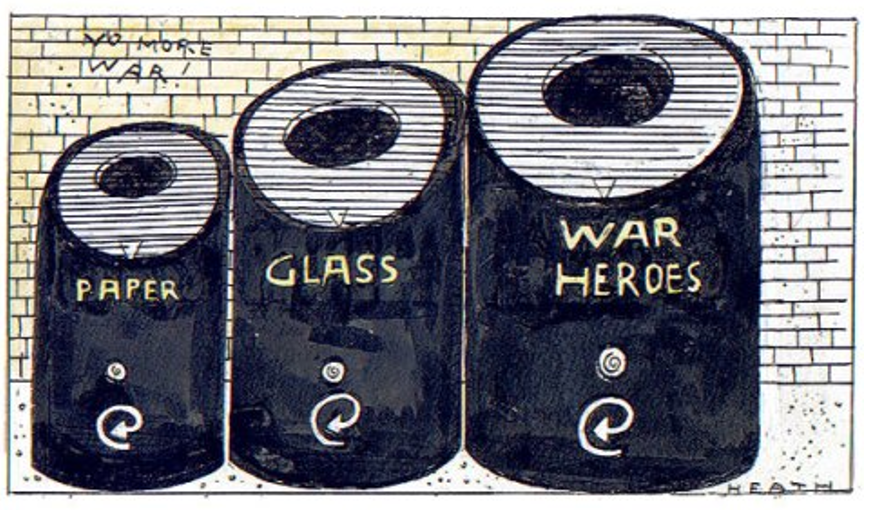
Forcing out war heroes is unjust
We must ensure that those wounded in wars leave the military at a time that suits them and are not thrown out onto civvy street (“War heroes to be axed in army cull”, News, last week). Help for Heroes (H4H), the Ministry of Defence and other service charities have been working together to ensure they get the very best opportunities for successful futures. H4H has committed £64m and we are focusing on raising millions more.
Around £40m of funds will pay for five PRCs (personnel recovery centres) — not, as reported, to replace Headley Court in Surrey, but in addition to that wonderful rehabilitation centre. H4H will initially provide a further £15m to enable the wounded to obtain the skills and training they need, either in the military or as civilians. In partnership with the services and charities, we are making plans to ensure that support continues for life. We have no part to play in who should stay and who should leave.
Where we can make a difference is to put in place facilities to make the lives of the injured as good as they should be. They deserve nothing less.
Bryn Parry, Co-founder and CEO Help for Heroes
War heroes to be axed in army cull
Wounded soldiers to be discharged from the army without compensation as the MoD tries to make room for able-bodied replacements
Michael Smith and Maurice Chittenden
The Sunday Times September 5th 2010
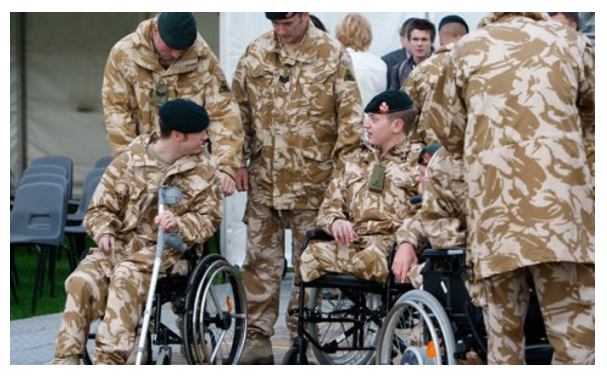
There are more than 200 amputees from the conflicts in Afghanistan and Iraq (Richard Pohle)
Wounded war heroes from Afghanistan and Iraq are to be forced out of the services in a cull that the government fears will provoke accusations of betrayal.
The Ministry of Defence is planning to axe 5,000 troops who are medically unfit, including the majority of those who have lost their limbs in bomb explosions and roadside ambushes.
The MoD has decided to throw the wounded largely onto the mercies of the Help for Heroes charity and the Royal British Legion. Some of the troops will receive one-off payments of only £6,000.
The cull has been ordered because the army has so many wounded on its books that able-bodied recruits are being turned away and its fighting strength is being diminished.
The 1st Battalion the Mercian regiment, one of the most battle-hardened units, has lost 25% of its strength. It has 300 fighting men in Afghanistan but has suffered 12 killed and 70 wounded in 4½ years. Financial controls restricting its headcount mean that it cannot recruit another 70 men to replace the injured while they remain in the army.
An MoD briefing paper obtained by The Sunday Times concedes that the cull of the injured will be seen as the “MoD discarding those who have sacrificed much on our behalf”.
The leaked document, Management of Army Personnel who are Medically Unfit for Service, says that 5% of the army is no longer fit to be deployed in combat. It adds that while “only a proportion of those discharged are likely to have been injured on operations … this number is likely to grow as operations in Afghanistan continue”.
The weakest 1,500 soldiers will be discharged first with another 750 going each year.
The cull will be seen as reneging on the promises by General Sir Richard Dannatt, then head of the army, that soldiers disabled on operations could stay in the forces.
Liam Fox, the defence secretary, said last night that he would order a review of the policy and blamed Labour for setting it in motion.
“I will want current ministers to review all these papers to ensure that those who have fought and sacrificed for their country are treated in a proper and honourable fashion,” Fox said.
This will put him at odds with General Sir David Richards, the current head of the army, who has concluded that the high numbers of troops being seriously wounded in Afghanistan meant many would have to leave.
“Difficult decisions will inevitably need to be made about individuals who already have a significant media profile. These will require careful handling,” says the leaked document, written by Belinda Vern, a senior civil servant at the headquarters of UK Land Forces at Wilton. Wiltshire. It was circulated to the offices of all ministers, the MoD’s senior civil servants and the army’s top brass.
The briefing paper says the cull needs to take place before “the public become … aware of the sheer numbers of seriously injured personnel in the army”.
There are more than 200 amputees from the conflicts in Afghanistan and Iraq. Eighteen soldiers have lost three of their limbs and 1,500 have been wounded in action in Afghanistan. The Royal Marines have set up a new unit, H company, especially for wounded men needing rehabilitation.
In the earlier years of the Afghan war, the MoD was keen to publicise amputees doing parachute jumps or marathons “before they return to their unit”. Soldiers wounded in Afghanistan were given desk jobs or lighter duties.
The new policy makes it clear that the services can no longer be expected to carry their wounded.
The MoD is risking particular criticism by relying on the Help for Heroes charity and the Royal British Legion to pay for the care of the wounded rather than doing so itself.
Several “personnel recovery units” are due to open next year around the country. These will be built in part by Help for Heroes with the £4m a year running costs funded by the Royal British Legion. The legion will help soldiers to recuperate, find jobs and adapt to civilian life.
It will also fund the construction and running costs of a “battle back” centre, which will provide sports and adventure training to help disabled soldiers return to fitness. The system will have the capacity to deal with a total of 250 troops at any one time.
Soldiers discharged for purely medical reasons, such as those wounded in Afghanistan or Iraq, will be given tax-free war pensions, depending on the scale of their injuries. But they will receive no additional compensation payments for being discharged early.
Among the total cull of 5,000 there will be a separate category of soldiers discharged for non-medical reasons, such as lack of fitness.
These soldiers will effectively be sacked under a system known as “manning control”, the MoD confirmed. This is a cost-cutting measure to prevent a soldier clocking up a 22-year service which entitles him to an immediate pension and redundancy.