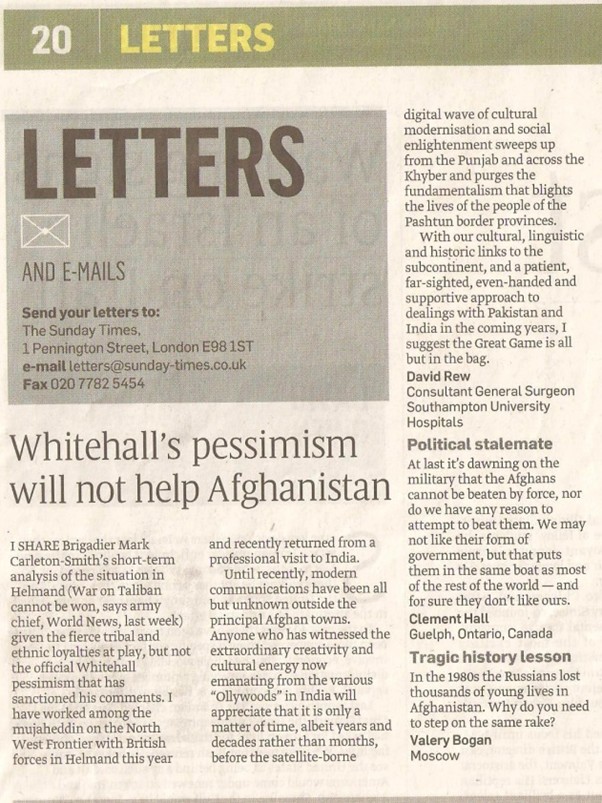

The Sunday Times 12th October 2008 - Long Term Outcomes in Afghanistan - 30 Downloads
The Sunday Times - Long Term Outcomes in Afghanistan
12th October 2008, David A Rew, Consultant Surgeon
Background
The mountains, plains and deserts of Central Asia and the North West Frontier in particular have had a powerful grip on the British imagination, and have acted as a magnetic and dangerous draw for centuries, as captured and de-romanticised in particular in the poetry of Rudyard Kipling.
In recent centuries, the First Afghan War of 1842; the Second Afghan War of 1878; the Third Afghan War of 1919 and the Fourth Afghan War of 2002 onwards have always ended in an Away Score Draw, in which the Afghans keep Afghanistan, the Brits retreat with their tails between their legs, and the Score is measured in the number of lives destroyed on either side. I have written in greater detail elsewhere on my time on the North West Frontier in 1988 (see https://eprints.soton.ac.uk/499214/) and on my (2012) perspectives on Strategic Outcomes in Central Asia (see https://www.researchgate.net/publication/352169355).
I also made a number of visits to India between 2008 and 2016 in working with colleagues for The Indian Association for Surgical Oncology (IASO). On these trips, I was struck by the huge creative energy that had been unleashed through mass communication and The Internet, which was gradually penetrating Afghanistan.
In the matter of short to medium term development outcomes in Afghanistan, the resurgence of religious fundamentalism and male misogyny with the Taliban led to the collapse of Western influence in Afghanistan in 2021. The unseemly air evacuation of August 2021 was a modern technical version of the retreat under General Elphinstone from Kabul of 1842, all be it with far fewer lives lost.
Therefore, in terms of the optimism expressed in my letter of 12th October 2008, I should perhaps have included perhaps I should have appended “centuries” to years and decades.
Nevertheless, the sentiment remains that modern communications and cultural influences may ultimately reshape societal structures in Afghanistan, where a brutal mindset has been profoundly shaped by a brutal landscape.
I reproduce here Mark Carleton-Smith’s published interview with Christina Lamb of 5th October 2008, which prompted my letter. He was of course absolutely correct in his judgement of this particular campaign: “the Fourth Afghan Campaign of 2002 to 2021”.
War on Taliban cannot be won, says Army Chief
Christina Lamb, Helmand, Afghanistan
The Sunday Times, October 5th, 2008
“Britain’s most senior military commander in Afghanistan has warned that the war against the Taliban cannot be won. Brigadier Mark Carleton-Smith said the British public should not expect a “decisive military victory” but should be prepared for a possible deal with the Taliban.
His assessment followed the leaking of a memo from a French diplomat who claimed that Sir Sherard Cowper-Coles, the British ambassador in Kabul, had told him the current strategy was “doomed to fail”.
Carleton-Smith, commander of 16 Air Assault Brigade, which has just completed its second tour of Afghanistan, said it was necessary to “lower our expectations”. He said: “We’re not going to win this war. It’s about reducing it to a manageable level of insurgency that’s not a strategic threat and can be managed by the Afghan army.”
The brigadier added: “We may well leave with there still being a low but steady ebb of rural insurgency . . . I don’t think we should expect that when we go there won’t be roaming bands of armed men in this part of the world. That would be unrealistic and probably incredible.”
Carleton-Smith insisted that his forces had “taken the sting out of the Taliban for 2008”. But his brigade has sustained heavy losses in the southern province of Helmand in the past six months, with 32 killed and 170 injured. In an interview with The Sunday Times, he added his voice to a growing number of people arguing that the conflict in Afghanistan could be resolved only through a political settlement that could include the Taliban.
“We want to change the nature of the debate from one where disputes are settled through the barrel of the gun to one where it is done through negotiations,” Carleton-Smith said.
“If the Taliban were prepared to sit on the other side of the table and talk about a political settlement, then that’s precisely the sort of progress that concludes insurgencies like this. That shouldn’t make people uncomfortable.”
Last week Gulab Mangal, the governor of Helmand, said the Taliban controlled more than half the province despite the increased presence of British forces.”