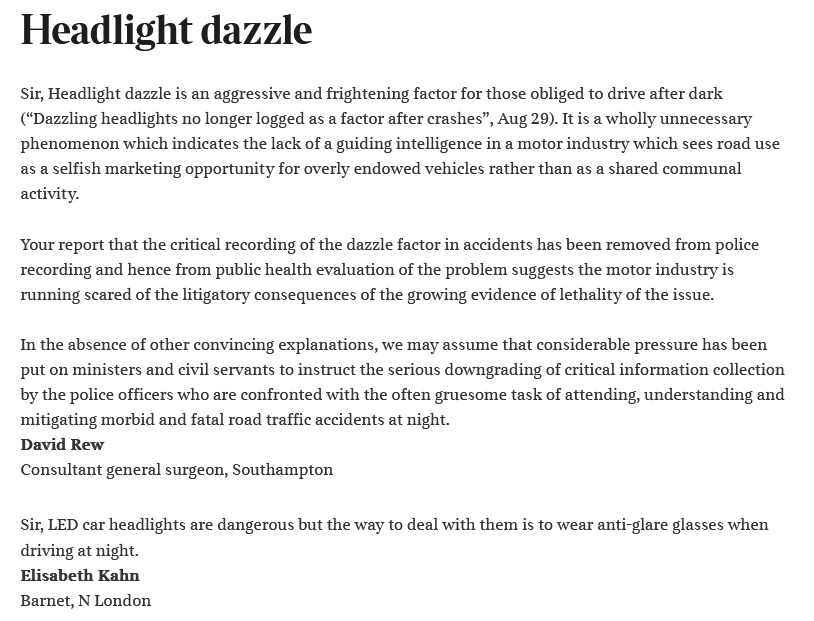

The Times - Headlight Dazzle
31st August 2026, David A Rew, Consultant Surgeon
Sir, Headlight dazzle is an aggressive and frightening factor for those obliged to drive after dark (“Dazzling headlights no longer logged as a factor after crashes”, Aug 29). It is a wholly unnecessary phenomenon which indicates the lack of a guiding intelligence in a motor industry which sees road use as a selfish marketing opportunity for overly endowed vehicles rather than as a shared communal activity.
Your report that the critical recording of the dazzle factor in accidents has been removed from police recording and hence from public health evaluation of the problem suggests the motor industry is running scared of the litigatory consequences of the growing evidence of lethality of the issue.
In the absence of other convincing explanations, we may assume that considerable pressure has been put on ministers and civil servants to instruct the serious downgrading of critical information collection by the police officers who are confronted with the often gruesome task of attending, understanding and mitigating morbid and fatal road traffic accidents at night.
David Rew
Consultant General Surgeon, Southampton
Background
In recent years, it has become increasing distressing and unpleasant to drive after dark because of the problem of headlight dazzle. We learn that the LED bulbs which have superceded the older halogen bulbs have around six times the luminosity of their predecessors. This translates into unnecessary ultra-bright headlights which dazzle oncoming drivers and which bleach night vision. Such lights also have a shock factor when met on bends of country roads.
These lights are the consequence of deliberate design choices by motor vehicle manufacturers and their engineering teams, when a reasonable compromise in light intensity between the old and the new headlight formats would have been perfectly possible.
On Saturday 29th August 2026, correspondent Will Humphries informed Times readers that ‘Dazzling headlights’ are no longer logged as a factor after crashes”

Dame Jenni Murray, who died in March after a crash, said she had been “dazzled by vehicle lights”
“The government will not know how often “dazzling headlights” cause road traffic accidents because it stopped police recording them as a contributory factor, The Times can disclose. An inquest into the death of Dame Jenni Murray heard that the broadcaster died of pneumonia days after being injured in a car crash caused by her being “dazzled by vehicle lights” on a road near Hampstead Heath, north London, in March.
The role of “dazzling headlights” in the crash will not show up in the UK’s road safety statistics because a government review removed it as a contributory factor that police officers attending collisions can report.
Since 2023, the “dazzling headlights” category has been replaced with a vague category of “distraction to driver/rider from inside/outside or on vehicle”. It means that the number of collisions involving drivers dazzled by headlights is not isolated. Instead, the issue has been folded in with all the other distractions that could affect a driver, such as those caused by animals, people or objects.
Edmund King, the president of the AA, said: “It is somewhat ironic that at exactly the time drivers are increasingly concerned about dazzling headlights, the government has removed the specific statistical category that allowed us to measure whether glare was contributing to crashes. The authorities need to weigh up the benefits of clearer vision enabled by these [brighter] lights with the concerns and dangers of glare.”
Police first began recording contributory factors in 2005 to provide insights into why and how road collisions occur. Labour commissioned an independent report in 2024 into “glare from vehicle lighting on UK roads”. The research had been promised by the previous Conservative government in response to a petition that received 14,107 signatures.
The report, produced by TRL, an independent transport consultancy, was published in October last year. It included the results of a survey of 1,850 people on the RAC drivers’ opinion panel, in which 97 per cent of motorists reported that they “regularly” or “sometimes” got dazzled by oncoming vehicle headlights.
More than half of drivers reported that they had stopped or reduced driving at night, or would if they could, owing to their perceptions of headlamp brightness. The report’s authors said: “Drivers reported that headlights are too bright, that higher ride-height vehicles are an issue and that road geometry is also important.”
A review of UK road safety statistics in 2018 recommended that data collection for contributory factors should be replaced with a road-safety factors dataset. The Department for Transport (DfT) said that the number of factors was reduced from 77 to 37, based on “those considered most analytically relevant, and better aligned to the ‘safe system’ pillars which support road safety policy development”. The department said that it was “hoped that the new system will support easier and more consistent recording”.
Police forces began switching to the new categories in 2023 and this year the DfT expects that all police forces will only record road-safety factors, which do not include “dazzling headlights” as an option.
Nicholas Lyes, a policy director at the Institute of Advanced Motorists, said: “There was a reason the reporting was changed — there were a lot of factors that overlapped and this meant there was more inconsistency in the previous data sets. However, as ‘dazzling headlights’ seems a clear factor, it would be useful to see it reported again.”
When police officers attend the scene of a collision, they are able to select up to six factors that they believe contributed to the collision. This highlights the key actions and failures that led to the impact and aids investigation of how collisions might be prevented.
Many people think the rising problem of dazzled drivers is caused by the increasing prevalence and power of light-emitting diode (LED) headlights.
Traditional halogen lights typically emit about 1,000 lumens, a measure of their perceived brightness, whereas the LEDs on new cars can be about 6,000 lumens. People in older cars are also upgrading their halogen lights with LEDs, which can often be illegal. LED lights are not certified for use in headlight units built for halogens and the Highway Code says that headlights must not dazzle other road users.
Rod Dennis, a senior policy officer at the RAC, said that Murray’s “tragic case ... underlines once again the need to do something about headlight dazzle”. He added: “This is especially important given more than half of drivers affected by glare who we surveyed this year said the problem had worsened over the previous 12 months. We understand the government is due to begin its second phase of research into headlight dazzle later this year. We very much hope it delivers answers that lead to meaningful improvements.”
In its 2026 road safety strategy, the government committed to further research into headlamp glare. The DfT said the way collisions were recorded was updated to “make reporting simpler and more accurate for police officers”, while the separate “dazzling headlights” category was removed “because relatively few collisions were being recorded this way”. A DfT spokeswoman said: “We hear the concerns about headlamp glare, which is why we’re investigating the causes as part of our road safety strategy.”