
Times letters: Rwanda plan, the law and Rishi Sunak’s future - 9th December 2023 - 30 Downloads
The Times - Rwanda plan, the law and Rishi Sunak’s future
9th December 2023, David A Rew, Consultant Surgeon
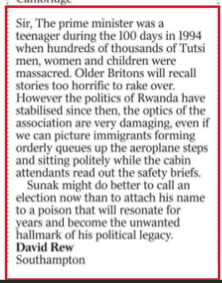
Sir, The prime minister was a teenager during the 100 days in 1994 when hundreds of thousands of Tutsi men, women and children were massacred. Older Britons will recall stories too horrific to rake over.
However the politics of Rwanda have stabilised since then, the optics of the association are very damaging, even if we can picture immigrants forming orderly queues up the aeroplane steps and sitting politely while the cabin attendants read out the safety briefs.
Rishi Sunak might do better to call an election now than to attach his name to a poison that will resonate for years and become the unwanted hallmark of his political legacy.
David Rew, Southampton
Background
Rishi Sunak was a Southampton boy whose family history has been well documented in the public domain. His parents were near neighbours and both highly regarded health professionals in the local community. I had closely followed his stellar educational achievements at Winchester College, Oxford and Stanford Universities; his subsequent work in high finance and his rapid ascent through talent and youth in the by then very toxic and divided Conservative political ranks in the post Johnson/May/Truss premierships.
He inherited what I judged to be the utterly toxic policy of expulsion of illegal immigrants to Rwanda, which was being sold as a safe haven for human exports but which had been at the centre of one of the most crude terrible genocides of recent decades. I had heard during Army bar talk of the evil massacres which had come to the notice of military medics of 23 Parachute Field Ambulance, to which unit I had been attached during Operation Granby (Desert Storm) in The Gulf in 1991.
The article of 8th December 2023 which prompted my letter was as follows:
We’re open to compromise on Rwanda deal, insists Tom Pursglove
Sunak says his plan is the only way as centrist and right-wing MPs threaten to rebel
Matt Dathan, Home Affairs Editor; Steven Swinford, Political Editor
Friday 8th December 2023
The government is open to compromise with rebel Conservative MPs over the Rwanda deal, a minister has said today, despite the prime minister insisting that his new law aimed at reviving the policy was the “only approach”.
Tom Pursglove, the minister for legal migration, said ministers “will engage constructively with parliamentarians around any concerns that they have” amid growing signs that the government faces rebellions from both flanks of the party.
Rishi Sunak was told by lawyers that his emergency Rwanda scheme will be “seriously impeded” from working because it “provides an easy way” for migrants to avoid deportation, although he insisted it was the only approach that would prevent further legal challenges scuppering flights. He said he was confident that flights would take off before the general election, and pledged to “finish the job”.
However, The Times has been told that Downing Street was warned by two senior lawyers that the scheme risked failure because it would continue to allow migrants to lodge challenges against their individual removal to Rwanda. Legal advice from a senior government lawyer said “the scheme would be seriously impeded” if the bill did not include a so-called “ouster clause” that barred individual legal challenges.
Separate external legal counsel that was sought by the government warned that the failure to bar individual challenges “is inconsistent with the intellectual underpinning of the bill and also would provide an easy way for many applicants to avoid the effects of the bill”.
A government source said in response: “Since this bill was published, a raft of eminent lawyers have advised that this bill means that the courts will not be able to block us from getting flights off to Rwanda to stop the boats. This includes Lord Sumption, the former Supreme Court judge, who said he believes the legislation will work on the basis that ‘the courts will do what they are told to do’.”
The Safety of Rwanda Bill, presented to parliament on Thursday, will bar systematic challenges being brought against the policy by instructing immigration officers, courts and tribunals to treat Rwanda as a “conclusively safe country”. However, clause four of the bill is seen by critics of the legislation as a weakness because it says that people can make claims if there is “compelling evidence relating specifically to a person’s individual circumstances”.
A senior Conservative MP and lawyer said that this would leave the courts “inundated” with legal claims from migrants helped by immigration lawyers who would “come up with a whole range of innovative reasons why Rwanda is unsafe for a particular individual”.
Pursglove defended the cost of the Rwanda scheme after the Home Office revealed that the overall bill had more than doubled, telling Times Radio it was “right” to support the African country build the necessary infrastructure. Sir Matthew Rycroft, the department’s permanent secretary, disclosed that an extra £100 million had been paid to Rwanda in April and estimates that another £50 million will be handed over next year, in addition to the £140 million bill for the deal in 2022.
The funds transferred to Rwanda are in addition to millions of pounds spent defending the legal challenges against the policy, operational and staffing bills and costs incurred from trips by three consecutive home secretaries to Kigali over the past 19 months.
Robert Jenrick, who quit as immigration minister on Wednesday, said that the bill would continue to allow the “merry-go-round of legal challenges which risk paralysing the scheme”. He argued that it would “negate” the Rwanda policy’s deterrent effect because migrants would know they had at least a chance of frustrating and delaying their removal from the UK.
Lord Cameron of Chipping Norton, the foreign secretary, said that the government would publish a pack of evidence showing the “true nature” of life in Rwanda to counter the Supreme Court’s criticisms of the country’s asylum system.
Pursglove said that Conservative MPs must “rally around and support” the Rwanda bill. He said it was “very significant legislation”, adding: “It’s the strongest piece of a legal migration legislation there has ever been. And what I want to see is Conservative MPs to rally around to support it. And I would hope that colleagues across the House will as well.”
Yvette Cooper, Labour’s shadow home secretary, said: “This is just incredible. The Tories have wasted an astronomical £290 million of taxpayers’ money on a failing scheme which hasn’t sent a single asylum seeker to Rwanda. How many more blank cheques will Rishi Sunak write before the Tories come clean about this scheme being a total farce? Britain simply can’t afford more of this costly chaos from the Conservatives.”
Sunak admitted that the bill would still enable individuals to lodge legal challenges against deportation but insisted the legislation left “extremely narrow exceptions”. The threshold was so high for succeeding in bringing an individual claim that it would make successful challenges “vanishingly rare”.
He has decided to delay the main showdown in the Commons over the bill until after the new year to give him more time to win support for his legislation. He faces the threat of rebellions on both flanks of his party.
Right-wing Conservative MPs are expected to lay amendments banning individual challenges and have also criticised Sunak for failing to include an effective opt-out from the European Convention on Human Rights (ECHR). They are waiting for a “star chamber” of legal experts to deliver their verdict over the weekend.
MPs in the centrist One Nation caucus, which has 106 members, are increasingly worried about the bill after they were given an initial legal verdict by Lord Garnier, the former solicitor-general. Sources said that “concerns are being raised” because of measures in the bill that will disapply sections of the Human Rights Act and questions over its compliance with the ECHR.
Tory whips are confident that the legislation will pass its first Commons hurdle when it comes before MPs on Tuesday for its second reading. MPs are expected to wait until the later stages of the bill’s passage to rebel. The most contentious stages are likely to come in early January.
A senior MP on the right of the party said he expected most colleagues to back the bill on Tuesday “with the view of improving it at a later stage”. However, there is still a risk from the centrist wing — only 29 Tory MPs need to vote with Labour to torpedo the bill.
The prime minister told a Downing Street press conference that his bill was the “only approach” that would succeed given Rwanda’s concerns about Britain breaching international obligations. Sunak said: “So for the people who say you should do something different, the difference between them and me is an inch, given everything that we have closed. We’re talking about an inch.
But that inch, by the way, is the difference between the Rwandans participating in this scheme and not. And as I said in my remarks, there’s no point having a piece of legislation which means you can’t actually send anyone anywhere.”
Richard Holden, the Tory party chairman, said that a new leadership contest would be “insanity”. There is growing speculation that Tory MPs on the right of the party could submit letters of no confidence in Sunak.