
The Times, 16th January 2025 - Failure to act on inquest advice blamed for thousands of deaths - 34 Downloads
The Times - Failure to act on inquest advice blamed for thousands of deaths
16th January 2025, David A Rew, Consultant Surgeon
Inquests ignored
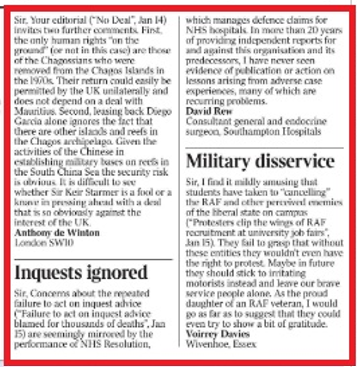
Sir, Concerns about the repeated failure to act on inquest advice (“Failure to act on inquest advice blamed for thousands of deaths”, Jan 15) are seemingly mirrored by the performance of NHS Resolution, which manages defence claims for NHS hospitals. In more than 20 years of providing independent reports for and against this organisation and its predecessors, I have never seen evidence of publication or action on lessons arising from adverse case experiences, many of which are recurring problems.
David Rew
Consultant General and Endocrine Surgeon, Southampton Hospitals
Background
As an interesting and challenging element of my professional clinical practice, I have provided a large number medicolegal reports on claims for clinical negligence for claimants and defendants. Many of these claims have been on similar cases and similar errors.
NHS Resolution, which is the central UK agency for the management of such claims, holds a very large number of such case files, from which major lessons could presumably be learned to inform best clinical practice. Indeed, NHS Resolution states that it invites insightful feedback.
Despite the stated good intentions, I have not been aware of published outputs with clear messages from the organisation in the surgical domain, and the most recent annual corporate report of the Agency provides no clarity beyond generic aspirations as to how such insights might be secured and promulgated. Many case settlements are wrapped in confidentiality clauses, which further impede the ability of front line clinical practitioners to understand outcomes, financial settlements or the factors which make break medico-legal cases. In consequence, defensive practice is often excessive and wrapped around in mythology and uncertainties.
I had not previously focussed on this issue in respect of coroners reports, and I am not aware that my letter has in any way moved the dial of NHS Resolution’s corporate plans.
The matter stands in stark contrast to the Aviation Industry, where rigorous analysis, no-blame reporting and an open approach to information has produced huge improvements in air transport safety over the decades.
The original article by Sean O’Neill which prompted my letter is as follows:
Failure to act on inquest advice blamed for thousands of deaths
Sean O’Neill The Times 15th January 2025 (page 1)
Thousands of deaths could be prevented every year if public bodies acted on concerns highlighted at inquests.
Almost 82,000 deaths in 2022 were recorded by the Office for National Statistics in England and Wales as “preventable”, meaning they could have been avoided “through effective public health and primary prevention interventions”.
Measures that could slash that toll are highlighted by coroners in reports to prevent future deaths, about 500 of which are published every year.
Coroners have a statutory duty to alert public bodies - including ministers and their departments, NHS trusts, prisons or regulators - when they fear there is “a risk that future deaths could occur unless action is taken”. Recipients must respond in writing but are not required to address the concerns that are identified by coroners.
Katy Skerrett, the senior coroner for Gloucestershire, published a report last week following the inquest into the death of Thomas Kingston, 45, the husband of the King’s second cousin, who took his own life while suffering an adverse reaction to antidepressants.
Skerrett asked whether patients were made sufficiently aware of the risk of suicidal thoughts associated with taking the drugs sertraline and citalopram, which belong to a class of medication known as SSRIs (selective serotonin reuptake inhibitors) that are widely prescribed for anxiety.
The Times and the Preventable Deaths Tracker at King’s College London have identified 40 previous coroners’ reports in which the use of the drugs had been a problem - including several in which the coroners said people had not been fully informed of the increased risk of suicidal ideation associated with the medication.
Coroners’ reports of lethal dangers ‘vanish into ether’
Sean O’Neill, Lottie Hayton The Times, Page 16, 15th January 2025
Reports highlighting reforms that could save lives are written in fewer than 2 per cent of inquests in England and Wales, analysis has shown.
Coroners have a duty to alert organisations, government ministers and their departments to failures that led to avoidable deaths.
About 37,000 inquests were opened in 2023, but just 547 reports to prevent future deaths (PFDs) were written that year. No official mechanism exists to pass on lessons from those reports or to monitor whether action is taken.
Although public bodies that receive PFDs are legally required to respond, hundreds have been ignored since publication began in 2013. Organisations that do respond are not required to take any further action to address concerns over matters such as drug safety, healthcare provision or professional training.
Inaction causes fatal failings to recur again and again:
- A coroner asked last week whether patients were properly aware of suicide risks associated with certain antidepressants after the death of Thomas Kingston, 45, husband of the King’s second cousin. Several other coroners had expressed concern about inadequate labelling of selective serotonin reuptake inhibitors (SSRIs), but their warnings were overlooked.
- An inquest into the death of William Northcott, 39, opened this week in Exeter and is examining whether the antipsychotic drug clozapine was a contributory factor; coroners have written 17 previous reports suggesting reforms in its prescription and monitoring.
- Coroners have expressed concerns about the availability of a poison linked to suicides for four years, but the Home Office has not restricted it.
- At the inquest last year into the death from myalgic encephalomyelitis of Maeve Boothby O’Neill, 27, a Devon coroner complained: “I write a lot of these [PFD] reports and often nothing happens.”
A DECADE OF MISSED CHANCES
Since 2013 more than 5,400 PFDs have been published by the chief coroner. Each one marks an area in which changes - such as better recordkeeping, more staff training, clearer food or drug labelling or increased care provision - might have saved a life.
Analysis by the Preventable Deaths Tracker project at King’s College London revealed that 1,495 reports had not had any responses and 741 had received only partial responses.
Georgia Richards, founder of the tracker, said: “Very few PFDs have led to meaningful change, and often it’s not the PFD that triggered it. Change comes from additional factors like change in leadership of the organisation, huge media scrutiny or dedicated families.”
SYSTEM IS ‘A WASTE OF TIME’
Although they are considered serious enough to warrant a coroner’s investigation, the deaths involved often result in no reports. Almost half of the 900 coroners in England and Wales have not written any PFD reports; 37 per cent of the reports have been written by just 30 coroners.
Richards said it was “mind-blowing” that there was no system to disseminate lessons from inquests. “Across 5,000 reports over the last 12 years, it is impossible to know anything about what action might or might not have been taken following a coroner’s report,” she said.
“People think there must be a system that’s protecting us. We assume that if you were in government you would want to know what’s happening in these death investigations.
But the system doesn’t work. It’s a waste of time.”
TWO-YEAR BACKLOG
Merry Varney, an inquest specialist at the law firm Leigh Day, said: “Sadly PFD reports and the responses promising actions are not effectively monitored ... Lives are lost unnecessarily as well as others undoubtedly suffering non-fatal harms from the same risks.”
Deborah Cole, executive director of the campaign group Inquest, said: “There is a serious gap in accountability after a coroner issues a PFD. While there is a duty for those who receive reports to respond, responses are often late, of poor quality or simply never sent. In effect, PFDs just disappear into the ether.”
Sir Peter Thornton KC, chief coroner in 2012-16, said: “First, there are not enough coroners writing these reports. Second, they can’t force a response. Third, they can’t follow up a response.
Fourth, they can’t force action - they can only suggest that an area of action is considered. And last, there’s no national follow-up; there’s no coordination.”
He urged reform through the creation of a national coroner service.
The inquest system is jointly managed by the judiciary, local councils and the police. It is poorly funded and has big backlogs: 1,685 bereaved families have been waiting longer than two years for hearings.
The chief coroner, Alexia Durran, declined an interview request. Her office said producing PFD reports was “an ancillary part of the coroner’s judicial role” and that issuing them marked the end of a coroner’s part in the process. Questions about what followed were for the government.
Analysis: I’ve spent years trying to make sense of our lethally flawed system
If you lose a loved one following a failure in care, you might assume that a robust system is ready to investigate and act (Georgia Richards writes on p 17 The Times 15th Jan 2025).
Thousands of families experience this “system” every year. Nearly 37,000 inquests were opened in 2023 to investigate who, how, when and where the deaths occurred. Inquests vary widely - some last weeks and have juries while others are concluded in writing without a court hearing - but all involve immense resources and are hugely distressing for those who have to relive the trauma of their loss or provide evidence as witnesses. So what happens afterwards? Coroners have a statutory duty to write to organisations, including hospitals or the government, if they believe that action should be taken to prevent future deaths. These prevention of future deaths (PFD) reports have been published online since 2013, but no one knew how many reports were being written, who received them, whether responses were sent and whether action was taken following the reports.
Now, after years of research - dedicating every spare moment and my personal funds to creating the Preventable Deaths Tracker - it’s possible to understand what’s going on. In 2023 only 1.5 per cent of inquests led to a PFD - that’s just 547 reports.
The flow of key information relies on the email etiquette of thousands of recipients. First, the coroner must email the report to the listed addressee - and there are likely to be multiple addresses. Next, the addressees must receive the report, formulate a response and reply within 56 days. If the coroner’s office receives a reply, they forward it to the chief coroner, who is responsible for redacting and publishing the reports.
If I do my maths correctly, that’s a minimum of three emails for a single report with one addressee. Since 5,443 reports had been published as of December 15, last year, that’s at least 16,329 unnecessary emails. It gets worse, however. Reports are then manually published online at judiciary.uk, leading to a wealth of errors and inconsistencies.
In Australia and New Zealand, information from every inquest is collated in the national coronial information system. This has been functioning for 25 years and is actively used to save lives.
The system, which has ten staff, was set up in response to recommendations made following the Royal Commission into Aboriginal Deaths in Custody. Governance, licensing and funding had to be agreed and approved by the leaders of each state and territory - a challenge that the English and Welsh system does not need to overcome.
The system’s success is about more than mere data. It is hosted by the state of Victoria’s department of justice and community safety, while the Victorian Institute of Forensic Medicine is tied to Monash University; academic research provides evidence to improve the justice system and save lives.
In England and Wales, the same deaths continue to occur. The inaction and inability to learn lessons from deaths is harming the living.
A system without a memory that relies on the goodwill of campaigners for action to be taken should be a national scandal.
To truly learn lessons from preventable deaths, we cannot continue inefficient and outdated practices. To start the transformation, a national database of inquests - and an independent, interdisciplinary research unit that works alongside the coroner service to inform policy and prevention - needs sustainable funding. Until then, the Preventable Deaths Tracker will keep tracking.