
The Times 24th November 2025 - Scepticism over claims made about Covid - 30 Downloads
The Times - Scepticism over claims made about Covid
24th November 2025, David A Rew, Consultant Surgeon
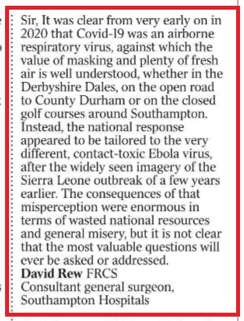
Sir, It was clear from very early on in 2020 that Covid-19 was an airborne respiratory virus, against which the value of masking and plenty of fresh air is well understood, whether in the Derbyshire Dales, on the open road to County Durham or on the closed golf courses around Southampton.
Instead, the national response appeared to be tailored to the very different, contact-toxic Ebola virus, after the widely seen imagery of the Sierra Leone outbreak of a few years earlier. The consequences of that misperception were enormous in terms of wasted national resources and general misery, but it is not clear that the most valuable questions will ever be asked or addressed.
David Rew FRCS
Consultant General Surgeon, Southampton Hospitals
This letter which I titled “The Wrong Virus” grew out of my operational experience in military service in the Gulf in 1991 and again in 2003.
Those who have been trained in Nuclear, Biological and Chemical (NBC) defence drills are familiar with the 9 second rule, which is the time available to “mask up” with Respirators on direct observation and immediate proximity to a chemical attack.
In the Gulf War of 1990-1991, there was initial concern that the Iraqis had a stock of chemical weapons which they might further weaponise as warheads on ballistic and other missiles. Sporadically, they would launch Scud Missiles (1990-91) and Silkworm Missiles (2003) in the direction of allied troop concentrations and logistic hubs.
These hypervelocity missiles had high immediate impact energy but little explosive impact, but for one tragic strike on a US Mess Hall in Al Jubail towards the end of the campaign. However, they had massive strategic impact through the panic that they induced in field commanders, who ordered troops theatre-wide to “mask up” whenever missile launches were detected at source by satellites. Given the heat of the desert, the wearing of chemical warfare suits was intolerable, life threatening (from heat stroke) and wholly unnecessary. It also induced serious operational and training disruption on numerous occasions.
Not only was masking up ordered in the absence of a missile on the horizon, let alone overhead, but I had learned that scientists from Porton Down had tested a range of nerve agents in the desert and found them to be wholly ineffectual. This was because the heat vapourised and dispersed volatile agents in minutes, while the sand and dust of the desert was a highly effective form of “Fuller’s Earth” for the fixing and immediate degradation of persistent (liquid) agents.
Therefore, the wearing of full NBC suits was seemingly unnecessary, and NBC respirators would only need to be used judiciously for short periods in proximity to chemical agents.
This lesson went unlearned and the problem re-emerged in the Gulf in 2003. In one long distance alarm early in the campaign, the command staff of 202 Field Hospital were paicked into ordering the staff of the hospital into trenches in full NBC kit for much of the day, following which more than 30 staff were severely (but fortunately reversibly) affected by early heat stroke. As an old Gulf hand but with no influence over the command team, , I slipped out of sight in the shade behind a tent and enjoyed an untroubled afternoon.
The point of these anecdotes, as will be apparent, is that even when tried and tested protocols exist which are founded in common sense and rigorous analysis, a panicked command structure, whether military or civilian, will overreact to threats with excessive “risk mitigation” which in fact generates greater risk.
In this context, in the strategic planning exercises which we undertook in the context of various emergency scenarios, I often wondered at the panic that would be induced by the release of a “dirty bomb” of fissile/radioactive material in a terrorism incident in a city. While the actual radiation health hazard might be very limited, the consequences of the induced panic might be huge.
From the Gulf, we can fast forward to the Ebola Viral pandemic in West Africa in 2014-2015. Unlike respiratory toxins and pathogens, the Ebola has severe infectivity from contact with body fluids. Therefore, impermeable whole body suiting is essential, and the images of encased health care workers during the pandemic became seared in the public association of a viral illness with the requisite healthcare response.
When Covid 19 arrived, it was understood from very early on that this was a respiratory pathogen, for which effective masking was the appropriate protection. Moreover, it was soon apparent that the vulnerable population were the very elderly, the morbidly overweight and those with severe comorbidities, including children with cardiac disease Many younger people, including many health professionals of my acquaintance and their families, caught the virus and felt very unwell for a week or so but with no local mortality.
In this context, the lockdown almost certainly did far greater harm than would a more focussed approach, and many health professionals might have been spared the misery of working in high care environments in “Ebola suits” of PPE. Once again, it was the misapprehension of risk by officialdom that may have done the greater harm. The debate is unlikely ever to be resolved, but I felt it useful to contribute to it.