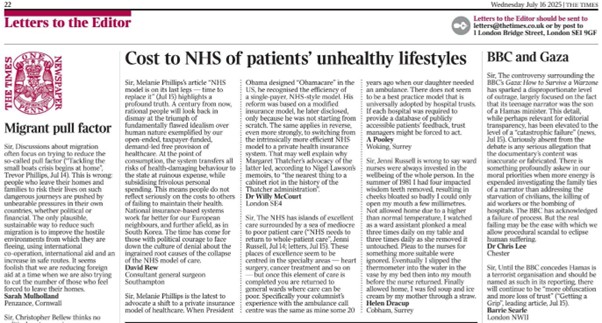

The Times, 16th July 2025, The Cost to NHS of patients’ unhealthy lifestyles - 33 Downloads
The Times - The Cost to NHS of patients’ unhealthy lifestyles
16th July 2025, David A Rew, Consultant Surgeon
Sir, Melanie Phillips’s article “NHS model is on its last legs — time to replace it” (Jul 15) highlights a profound truth. A century from now, rational people will look back in dismay at the triumph of fundamentally flawed idealism over human nature exemplified by our open-ended, taxpayer-funded, demand-led free provision of healthcare. At the point of consumption, the system transfers all risks of health-damaging behaviour to the state at ruinous expense, while subsidising frivolous personal spending. This means people do not reflect seriously on the costs to others of failing to maintain their health.
National insurance-based systems work far better for our European neighbours, and further afield, as in South Korea. The time has come for those with political courage to face down the culture of denial about the ingrained root causes of the collapse of the NHS model of care.
David Rew
Consultant General Surgeon Southampton
This letter was prompted by an article by the very brave thoughtful columnist Melanie Phillips in the COMMENT section on Page 24 of the Times on 15th July 2025.
Her thesis was that “The NHS model must be replaced to provide the equitable and efficient provision of healthcare”.
The NHS model of free health care with no direct linkage between the real costs either for the consumer (the patient) or the immediate provider (the health care professional) had troubled me for its idealistic but economically unsustainable foundations from the outset of my career. Indeed, I have long mulled on writing a book on “The National Ill Health Service”. In the absence of any controls to demand for free services, demand always exceeds supply, and in the absence of market signals, the responsibilities for funding expenditure devolve to administrators rather than to patients and clinicians.
Because patients are not provided with pricing information or encouraged to take direct responsibility for the costs of their care, personal funds are instead spent on consumer items other than elective healthcare. Spending decisions are channelled into vehicle purchases, long distance holidays and the cruise industry and supermarket aisles.
My own NHS clinical services over the past three years had been severely disrupted by the consequences of this failing financial model, so Melanie articulated and captured very clearly my own concerns very effectively.
NHS funding is politically toxic in defence of the status quo, so I felt that it was appropriate to offer her modest support for her courageous article through the letters column.
In May 2024, I had received superb emergency care in the Korean Health Service while on a working visit to Seoul, where there is a well ordered and transparently costed state insurance based system, where every activity, dressing and tablet is laser bar coded and recorded.
Here is her original article, as her clear message deserves repetition.
Melanie Phillips
The NHS model is on its last legs - time to replace it
Sacred-cow healthcare drains funds from rest of the state: Dutch system would be far cheaper
Melanie Phillips @melanielatest
At last, the unthinkable is being seriously thought about healthcare in Britain. The NHS is bust. More and more billions are periodically thrown at it, but its waiting lists are horrendous and relative to other comparable countries it does poorly in life expectancy and healthy life chances. Only the US does worse.
As the largest employer in Europe, the NHS has some 1.38 million fulltime equivalent staff who absorb almost half the budget for day-to-day spending. It’s virtually impossible to run efficiently, and examples abound of rotten management and excessive bureaucracy. So says a report by Policy Exchange, which declares that this has to end.
From 1955 to 2023, real health expenditure per capita rose by about 850 per cent. At 9 per cent of GDP, government health spending is almost the highest of all developed countries and by some estimates will rise to more than 20 per cent of GDP by 2070.
Without radical reform, says the report, other public spending would have to be squeezed or taxation would need to be increased to eyewatering levels. This would damage the economy so badly that “it simply cannot be allowed to happen”.
In his foreword, the former health secretary Sir Sajid Javid says Britain is now at a crossroads. The NHS model can’t cope with spiralling demand. It’s run entirely by the state and its agencies. By contrast, says Javid, the very best performing healthcare systems combine high levels of state subsidy, mandatory insurance, co-payments, and individual choice.
The report accordingly proposes replacing the tax-funded NHS by compulsory insurance, backed up by a publicly funded safety net to cover the poor, plus some element of copayment to incentivise people to look after themselves.
It recommends the model adopted by the Netherlands in 2006 under which people choose their insurance providers, with the state’s role reduced to regulating insurers and providing the safety net for those who can’t afford to insure themselves. Dutch healthcare costs are now proportionately lower than in the UK, waiting lists are smaller and health outcomes generally better.
The problem is that for decades, Britain has been living a lie
It has been clear for years that European-style social insurance systems fulfil the moral obligations of the NHS while providing better outcomes. Yet the NHS has been treated by Conservatives and Labour alike as the most sacred of political cows. This is even though it’s not just failing to deliver adequate healthcare but the enormous sums it’s swallowing are seriously distorting the economy, diverting essential investment from services ranging from education to defence.
However, the whole public sector is on its knees for which the NHS is not the principal cause. The criminal justice system, for example, is collapsing through sustained and serious underfunding. The retired senior judge Sir Brian Leveson has now controversially proposed to limit trial by jury to tackle the immense backlog of cases, some of which take years to come to trial and may have to be abandoned because of the passage of time. Limiting jury trial, however, won’t solve the problem because the lower courts are also under immense strain, as are the prisons and the police.
The essence of the problem is that for decades Britain has been living a lie. It has indulged itself in a welfare state without taking the measures to pay for it. This goes back to the end of the Second World War, when the Attlee government decided that the spirit of the times demanded the building of a brave new world based on collective provision and equality. Far less attention was paid to creating the wealth to pay for this nirvana. It was assumed that redistributing wealth from rich to poor would pay for it all.
Society thus moved from making to taking, producing less and less while telling itself that it had a right to welfare provision and that the rich should stump up. No government (other than Margaret Thatcher’s) was brave enough to deliver some essential home truths about spending above the country’s means.
Instead, governments lied that things were getting better and that more was being spent. In fact, the public sector was being salami-sliced to shuffle funds from one service to another; and all were being fleeced to pour more billions into the black hole of the NHS.
The ultimate symbol of this irresponsibility, and a principal force behind Britain’s slide from making to taking, has been the benefits system. According to the Centre for Social Justice, people claiming universal credit and payments for ill health will soon earn £2,500 more than through the minimum wage. The Office for National Statistics says nearly one in four working-age people are classified as disabled.
The NHS Confederation says that in 2021-22, 63,392 people went straight from university on to long term sickness benefits, with an incredible increase among 25 to 34- year-olds of 69 per cent in five years. Last week, Kemi Badenoch rightly said the UK was “sitting on a ticking time bomb” of spiralling welfare dependency, spending more on sickness benefits than on defence.
The NHS model must be replaced to provide the equitable and efficient provision of healthcare to which politicians pay such dishonest lip service, and to protect the economy from such damaging distortions. But the underlying issue of an unaffordable welfare state can only be tackled by a government brave enough to recreate the work ethic, and an economy that delivers the jobs to inspire it.